

WOMEN IN MARIGOLD
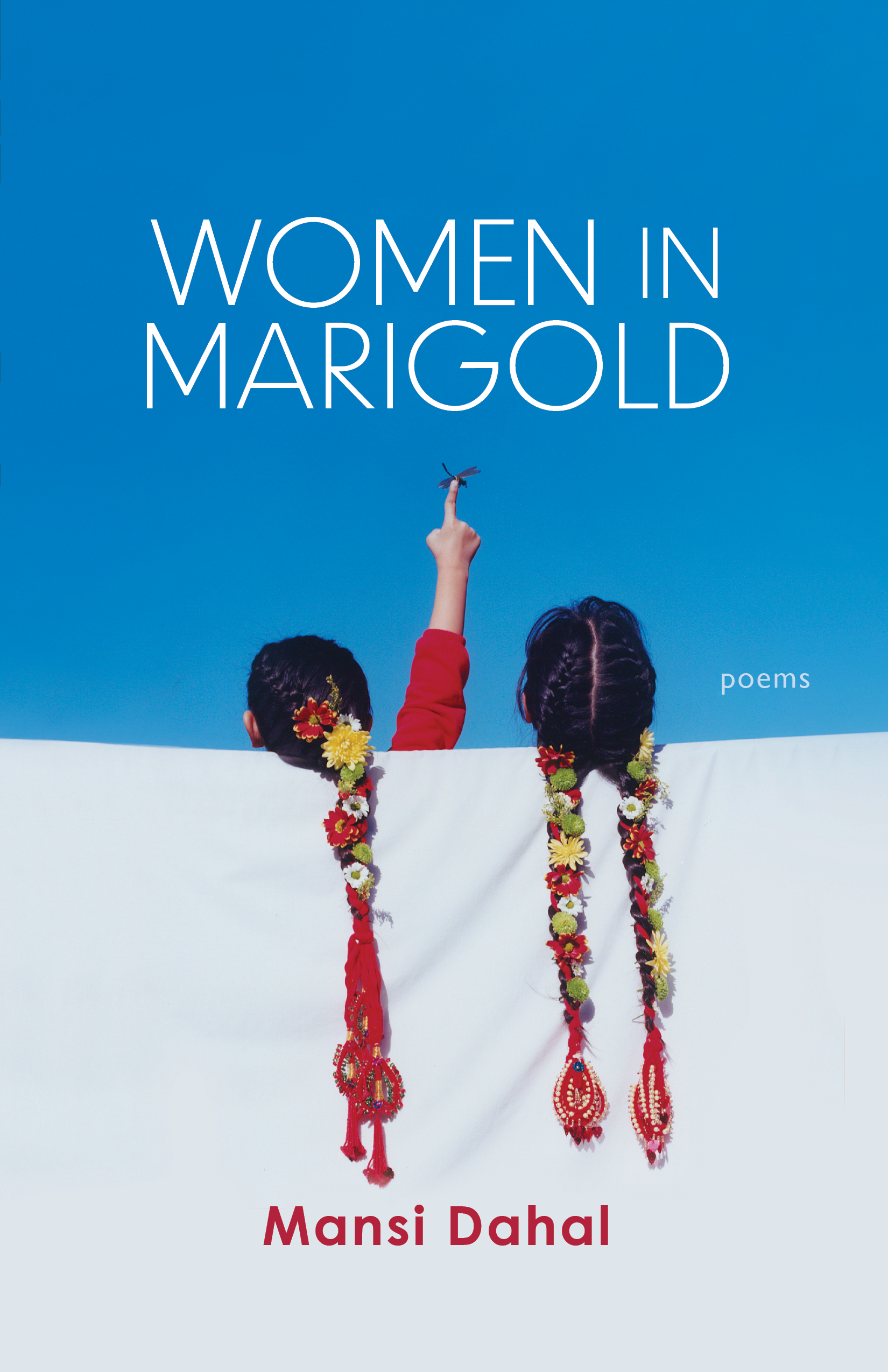
WOMEN IN MARIGOLD
By: Mansi Dahal
Categories: Paperback, Poetry
Sept. 22, 2026 | ISBN: 978-1-945233-34-0
AVAILABLE FORMATS
-
$18.00
Sept. 22, 2026 | ISBN: 978-1-945233-34-0
Distributor: Ingram
ABOUT WOMEN IN MARIGOLD
A POWERFUL AND LUMINOUS DEBUT FROM WALETZKY FELLOWSHIP POET MANSI DAHAL
Wilting coriander, etched steel plates, and long, dark hair spread on a beauty parlor floor—Mansi Dahal’s remarkable debut collection is intimacy over a kitchen sink, sheer evidence of presence. At its center is the ache of dislocation and the desire for rootedness, captured in a single, impossible wish: “Imagine being able to live / in one place at one time.” Interrogating what we inherit, Women in Marigold moves from Kathmandu to New York City, from Saeeda Bai to Sylvia Plath, confronting the tension between life as a daughter in Nepal and a future as an artist in America.
PRAISE FOR WOMEN IN MARIGOLD
“Imagine a ‘grave with Wifi.’ Imagine a door that opens ‘to no breaths.’ Women in Marigold formulates the devastation of scale as a condition of diasporic presence. Sometimes there’s a splinter. Sometimes there’s a house. Sometimes there’s a sea. Even the girl writing in the café, waiting for her ‘first Spring,’ notes the precarity of her inclusion in the American archive. ‘I will never arrive at the answer,’ writes Mansi Dahal, in a collection that speaks of home and the loss of home in measured, broken time.”
—Bhanu Kapil, Fellow of the Royal Society of Literature
“You must read Mansi Dahal’s radiant Women in Marigold. Read it once for the sense-details, for the ‘[g]irls who will buy an ounce of blood / to make sausages for their lovers.’ Read it again, for longing: ‘When the sun sets in Pokhara, I wait /for you like the cotton-candy man,’ and for longing’s opposite. Read it a third time for political precision, and for rage. ‘A nation is so / desperate for happiness, it made the sad ones disappear,’ she writes of the forcibly displaced ethnic Nepali Bhutanese, and for increments of exile: ‘Srujanee told me today that America has no soul, / just a system. A grave with Wi-Fi.’ And again, for the lyric claiming of political power. ‘I imagine myself in the meetings with the / prime minister. I imagine myself as the prime minister. I am the prime minister.’ Read it for homesickness, for the conundrum of belonging only in the bottomless in-between. These poems reawaken my openness to sensation and allow me to recall those days in which the intensity of desire is in equal measure to the impossibility of its fulfillment. They hold so much sadness they turn blue, ‘like Shivaji after swallowing the snake’s poison,’ and shimmer with the incandescence of a marigold.”
—Diane Seuss, author of frank: sonnets and Modern Poetry
“Reading this wisdom-filled and pleasure-forward first collection is like plunging oneself into a whirlpool of the senses, from the nearly audible sun-like vibrance of its titular flower, which rhymes visually with the ‘golden antennae’ and ‘orange abdomen’ of prawns ‘dipped in a karai full of boiling oil,’ to the ‘late night / drizzles that smell like rotten fish’ and the crisp, familiar tartness of ‘an almost ripe green apple.’ But this immersion in color, fragrance, taste and music isn’t meant to distract from the sorrow, suffering and injustice that Dahal is too keenly aware of ever to ignore, but instead to remind us of the joy that is always possible and must therefore always be worked toward and fought for. Dahal fathoms the world as one of ongoing change that we can either lie down and surrender to or else rise up and take a hand in, and never have I read a book that left me more conscious of how the act of writing, like that of all art—including fashion, cosmetics, and especially cooking—is the transformation of the particles of earth into something vital and new, a celebration of what’s possible in light of, and often in spite of, what is and has always been.”
— Timothy Donnelly, author of Chariot and The Problem of the Many

ABOUT THE AUTHOR
Mansi Dahal is a writer from Biratnagar, Nepal, and a graduate of Columbia University’s MFA program, where she was awarded the Waletzky Fellowship from the School of the Arts for her distinguished work. Her writing has been featured in POETRY, New England Review, Michigan Quarterly Review, Southeast Review, Copper Nickel, Colorado Review, Tupelo Press, Palette Poetry, and elsewhere. Her poem “What the Eye Chooses to See” was nominated by Copper Nickel for inclusion in the Best New Poets anthology, while her poem “Doll-House” was recognized as a finalist for Palette Poetry’s 2022 Sappho Prize. Poets & Writers selected her as one of their poetry fellows for the 2026 "Get the Word Out" publicity incubator program. Mansi holds a BA in English with a concentration in Media and Film Studies from Kalamazoo College. She served as the editor-in-chief of Some Kind Of Opening and splits her time between New York and Nepal.